
I’ve worked in an Emergency Operations Center, or EOC, almost every day since the Winnebago County tornado. When I mention it, I usually get the same question: What happens there?
An EOC helps coordinate a large, complex emergency across communities, agencies and organizations. It can operate in person, virtually or both.
The Puzzle
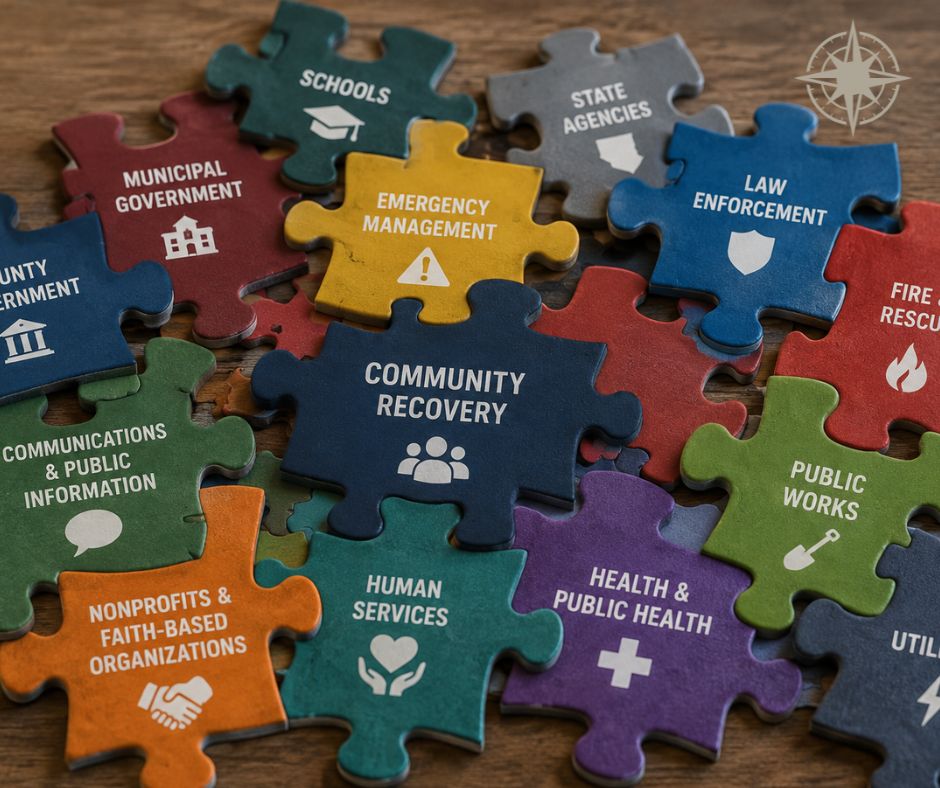
Think of a disaster like the tornado as a puzzle scattered across a table.
Municipalities have pieces. So do fire departments, law enforcement, public works, utilities, human services, nonprofits, state agencies and many others. Each knows what is happening within its area of responsibility and has its own needs, connections, processes, resources and decisions to make.
The EOC helps put those pieces together. As new information comes in, more pieces get added and the picture changes.
Representatives bring information from across the affected area so we can develop a broader picture of what is happening, identify needs and gaps, coordinate resources, address issues that cross jurisdictions, and anticipate what may come next.
The agencies or communities involved maintain their own authority and responsibilities. The EOC provides the structure that helps those separate efforts work together across a large response.
EOCs are Proven to Work
Emergency managers have used EOCs for decades at the local, county, state and federal levels. They expand, contract and change as an emergency moves from immediate response into recovery.
In our EOC, we meet every day, although now not over the weekend. Representatives report what happened since our last meeting. We discuss priorities, needs, available resources, unresolved issues and what we expect in the coming days.
The Value
The value goes well beyond sharing updates.
A community may need a resource someone else at the table can help locate. Several municipalities may face the same issue and benefit from a coordinated approach. Work planned by one agency may depend on another agency completing something first. A problem in one area may signal something we need to watch across the region.
We also share what we don’t know. Conditions and needs change. We verify information, identify gaps, and continually update the larger picture.
That picture also tells us where the response is headed.
Early on, public safety and immediate needs take priority. As those issues resolve, debris, housing, human services, financial assistance, infrastructure and other recovery needs may take on larger roles. The organizations represented in the EOC change along with those priorities.
Communications has a seat at the table, and that’s the role I help fill.
I hear directly from the partners involved in the response and bring in questions from residents, businesses and the media. I help find answers, identify where we need more information, and coordinate what and how we need to communicate with the other public information officers.
Only One Piece is Usually Visible
The public often sees only one piece of the response.
Residents want debris removed, roads opened, services restored and answers about what comes next. A task that appears straightforward may involve several organizations, a resource needed in multiple communities, or work that has to happen in a particular order.
Behind all of that, representatives in the EOC keep bringing their pieces back to the table as needs change and recovery moves forward. Then we return to our respective roles and continue the work.
The next day, we study the puzzle together again.


Leave a comment